Graham Sharp, VP of Sales and Marketing at BCNEXXT, reflects on the shift to fewer people and the same deliverables, explaining how Vipe’s intelligent automation and content-centric architecture replace legacy playout models to reduce costs while safeguarding quality and reliability.
We have heard the ‘do more with less mantra’ for some time, but at IBC this year it seemed to reach fever pitch as Broadcasters and service providers are being told to drastically cut costs, whilst supporting even more events and disribution methods. Just how do Broadcasters increase channel to operator ratios and reduce on-air incidents?
At BCNEXXT, our answer isn’t based on shiny features, but a new way of working where we co-develop playout workflows with our customers, automating repetitive tasks and presenting data on an exception basis, reducing the requirement to continually eyeball content and also therefore human-induced on-air incidents.
Using the latest rapid prototyping and continuous development methods, new functionality can often be released in a few weeks and migrated safely into production. This new way of working ensures new features and functionality directly align with broadcasters' goals of reducing costs and increasing reliability.
The Problem with Big-Bang Software Releases
Legacy playout systems were built for long development cycles and brittle, one-to-one channel management. New functionality often arrived as part of a yearly release, slow to land, risky to deploy, and disruptive to operations.
But when budgets are forcing consolidation, leaving operations with fewer human resources to manage the same workload or more, you don’t have the luxury of waiting for the next major upgrade. You need targeted workflow improvements delivered fast, so playout stays reliable even under tighter headcounts.
What Continuous Co-Development Looks Like
With BCNEXXT, co-development means:
1.Start with the operator’s real job. Whether it’s handling regional ad breaks or live sports cut-ins, we focus on automating the repetitive tasks that give operators the space they need to manage their workload effectively.
2.Prototype quickly. Within days, we deliver a working feature for feedback.
3. Refine the experience. Our UI team turns those new capabilities into clean, intuitive controls that simplify what used to be chaotic.
4. Deploy safely. Containerized microservices and Kubernetes pipelines mean new features drop into production without downtime.
5. Measure and repeat. Each sprint compounds capacity gains, without ever destabilizing the system.
Think of it as a loop: Request → Design → Automate → Ship → Measure. And it runs every day/week, not once a year.
Three Quick Wins for Operators
In practice, this approach shows up in ways that make a tangible difference for operators. Take promo placement: what once required multiple manual steps has been reduced to a single click. Instead of wrestling with tedious tasks, operators keep their eyes on air, not buried in workflows.
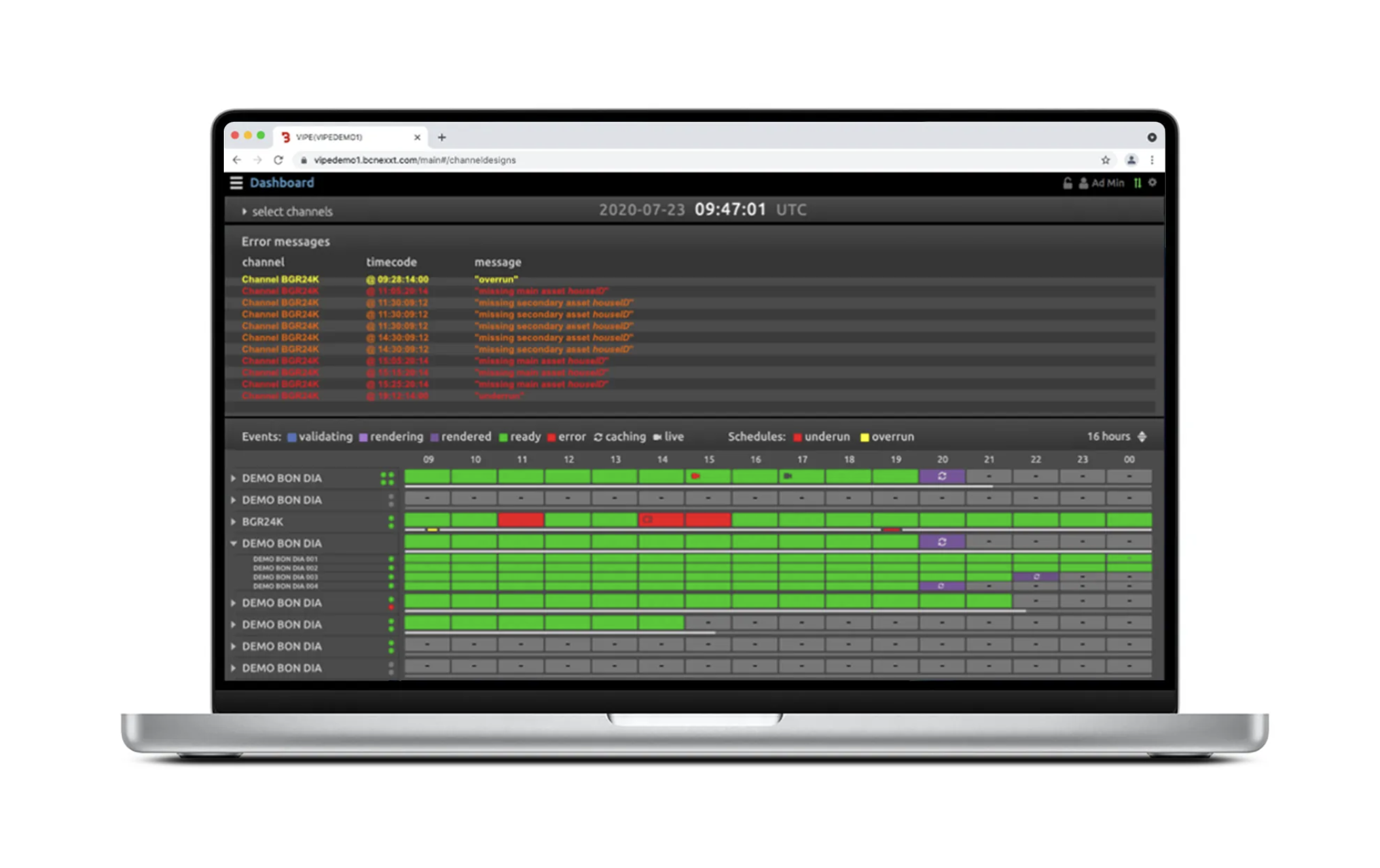
Or consider live multi-region events. Traditionally, operators had to juggle multiple columns of sometimes conflicting data across different feeds. Now, they can view everything in a single stacked perspective. Misaligned breaks jump out visually, creating a calmer, more manageable live playout environment even when juggling ten or more channels.
And then there’s machine learning. By analyzing schedules and dropping markers where breaks are out of sync, the system prevents missed spots or black frames before they ever happen. The result is a shift from reactive firefighting to proactive, confidence-driven playout.
The Tech That Keeps Playout Stable
Of course, speed doesn’t matter if it compromises reliability. That’s why every release is designed with stability guardrails in place. Updates are staged safely using blue/green and canary rollouts, ensuring new features can be validated before full deployment. Built-in observability means issues are detected and resolved before they ever reach air. And with microservices isolation, one new function can be introduced without disrupting the rest of the playout system.
This is the backbone of BCNEXXT’s model: rapid iteration that broadcasters can trust, knowing broadcasts will stay rock-solid even as capabilities expand week by week.
Proof in Weeks, Not Quarters
The results speak for themselves. From the very first deployments, customers reported infrastructure cost reductions for playout, specifically of around 60%. New automations remove redundancies and enable operators to have a broader view and control over playout. With user interfaces designed for clarity and calm, operators are comfortably running 10 live channels at once and more than 50 non-live channels.
These aren’t abstract projections. They’re the outcome of short, focused development cycles where customer requests for greater efficiency turn into new capabilities in a matter of weeks. Each iteration compounds the value: fewer manual steps, fewer shifts required, and more channels managed per operator, all without sacrificing the quality of the operation.
Talk to us about your efficiency goals and how co-developing your playout operations can help achieve them. Discover how Vipe can help https://www.bcnexxt.com/resources.





.jpg)



.jpg)
.jpg)
.jpg)
.jpg)
.jpg)











.jpg)


.png)


