For much of broadcast and early OTT history, playout was treated as a fixed technical function. It was something you deployed once, optimized for peak capacity, and rarely revisited. That model no longer reflects how streaming (or any other content distribution) businesses operate today.
As FAST and ad-supported streaming mature, playout has moved from the background into the center of strategic decision-making. According to Cédric Monnier, CEO of OKAST, this shift is being driven by economics and the ability to compete on audience experience.
“At OKAST, everything starts with monetization,” Monnier explains. “FAST, AVOD, SVOD, these are business models. Our role is to help content owners generate revenue across them. Infrastructure has to support that goal.”
FAST Changed the Operating Reality
FAST channels introduced a fundamentally different operational dynamic. Unlike traditional broadcast channels, designed for permanence, FAST channels are often short-lived, experimental, or highly dynamic. Some scale rapidly. Others run for months. Many evolve continuously.
This volatility exposed the limitations of legacy playout environments built on fixed hardware, static capacity planning, and localized infrastructure.
“As FAST accelerated, we needed to rethink how playout could support the business,” says Monnier. “The business scenario did not allow for long procurement cycles or building infrastructure for peak-capacity when channels may only exist for a limited time.”
As FAST matured, particularly in Europe, it also became more competitive. Platform slots are finite. Premium broadcasters and global brands entered the market. Viewer expectations around quality, reliability, and presentation increased.
In this environment, playout directly impacts monetization: speed to market, cost control, and the ability to iterate quickly all affect revenue outcomes.
Real-World Example: Geographic Expansion Broke the Old Model
OKAST’s original playout environment was designed for a very specific context: delivering channels from infrastructure located in France to French operators. At the time, that worked.
Hugely successful, OKAST’s business expanded; however, the infrastructure did not.
The company began distributing channels to platforms such as Rakuten TV, Samsung TV Plus, and Pluto TV, first across Europe and then into markets like the United States and Mexico. What had once been a localized, optimized setup quickly became a burden.
“Our infrastructure was never designed for that level of geographic reach,” Monnier says. “It worked when everything was local. But as soon as we started operating across multiple countries and platforms, it became extremely limiting.”
Everything else in OKAST’s platform stack had already been built in the cloud. Playout was the exception, and it would become a bottleneck if not resolved.
The challenge wasn’t ambition. It was architecture. Expanding distribution meant either rebuilding infrastructure region by region or rethinking playout entirely. The company deployed BCNEXXT’s Vipe in 2024.
BCNEXXT Vision: Playout Had to Be Liberated
Long before FAST reached this inflection point, BCNEXXT recognized that playout itself had become a constraint.
A decade ago, the team at BCNEXXT embarked on a technical journey rooted in a simple belief: playout needed to be liberated from fixed infrastructure, geographic boundaries, and one-to-one channel models. If streaming was going to scale globally and economically, playout had to become agile, elastic, and cloud-native at its core.
That vision became Vipe.
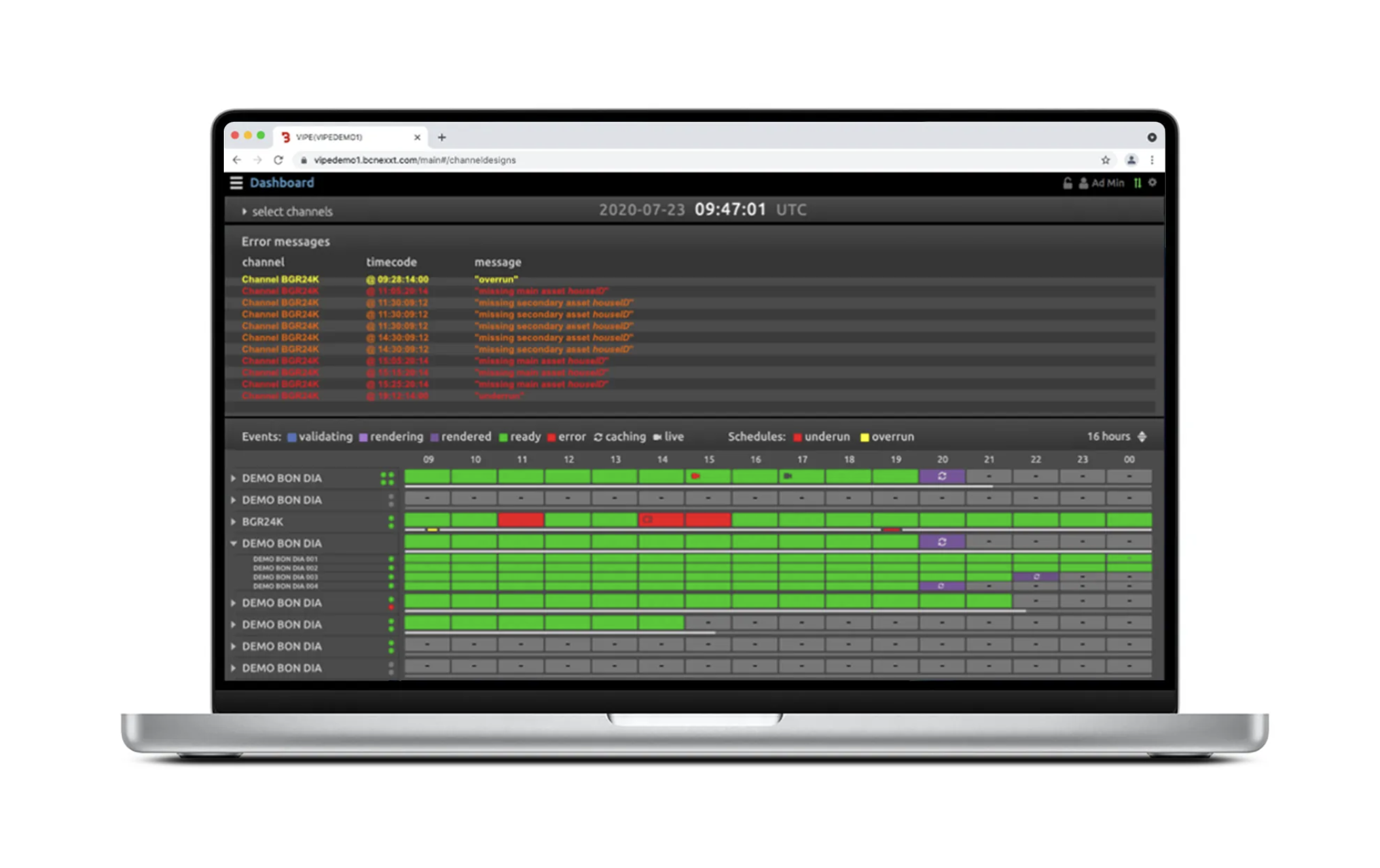
Built on a containerized microservices architecture, Vipe was designed to orchestrate resources dynamically based on actual channel needs, scaling up for live events and complex schedules, and scaling down for routine branding or looped content. The goal was not just efficiency, but freedom: freedom to launch faster, experiment more, and operate across regions without rebuilding infrastructure.
Sovereignty as Control, Not Constraint
Another dimension shaping modern playout decisions is sovereignty. Much of the FAST ecosystem, from ad tech to playout, has been dominated by non-European vendors. For operators like OKAST, this raised questions of control and differentiation.
“Sovereignty isn’t political for us,” Monnier notes. “It’s about control. Control over how we operate, how we evolve, and how we differentiate.”
As a founding member and coordinator of the ASAP4EU consortium, OKAST is working with European partners to build next-generation FAST and AVOD services designed for modern advertising, advanced monetization, and long-term scalability. A key requirement of this approach is a playout infrastructure that is flexible enough to evolve with new ad formats—interactive, addressable, and data-driven—while remaining fully aligned with European technology and values.
BCNEXXT’s European roots and cloud-agnostic approach align closely with this thinking. Vipe enables operators like OKAST to maintain technical independence, operate across multiple cloud environments, and expand across borders without being locked into a single vendor or geography.
“We chose BCNEXXT for three key reasons,” said Cédric Monnier. “First, they are a European company, which is fundamental to our strategy and to ASAP4EU’s objectives. Second, the richness of the feature set, at a time when channels require more live capabilities, more polish, and more sophistication. Third, Vipe is fully cloud native. We currently operate across AWS and Akamai, and that flexibility is critical to our model.”
Today, OKAST runs its services across multiple cloud environments to meet regional and operational requirements, ensuring scalability, resilience, and independence, while building a playout foundation capable of adapting to the next generation of European advertising and streaming innovation.
OKAST: Monetization in Practice
For OKAST, adopting Vipe was about aligning infrastructure with business reality. Operating across FAST, AVOD, SVOD, and hybrid models and across Europe and international markets OKAST required playout that could:
- Launch channels quickly
- Scale efficiently with demand
- Support premium viewing experiences
- Enable expansion beyond geographic boundaries
By implementing Vipe, OKAST modernized its playout infrastructure and freed its customers to focus on monetization rather than navigating the operational complexity.
“All new channels now launch on Vipe in the cloud,” says Monnier. “And as channels evolve, adding live content, higher quality, or more sophisticated presentation, Vipe adapts without rebuilding the foundation.”
Playout as a Strategic Foundation
As FAST and ad-supported streaming continue to evolve, operators who align with OKAST’s monetization strategy will be best positioned to compete, scale, and innovate. And with Vipe, playout is no longer a constraint; it’s a strategic foundation for the next generation of streaming.
Contact us for a demo.



.jpg)

.jpg)
.jpg)
.jpg)
.jpg)
.jpg)





.jpg)


.png)


