Sky Sport’s Sky Cube showcases the future of sports production, combining IP transformation, cloud playout, and AI-powered workflows, with Vipe enabling scalable, high-performance operations.
We’d like to extend our sincere thanks to Mebucom and author Niklas Eckstein for this excellent behind-the-scenes feature, “Sports production in transition: A tour through the Sky Cube”. Thanks to Christian Barth, Director of Production Platforms & Playout, and Alessandro Reitano, Senior Vice President of Sports Production at Sky Sport for sharing such valuable insight into how one of Europe’s largest sports broadcasters is evolving its workflows, bringing together IP transformation, cloud scalability, and modern editorial production inside Sky Cube in Unterföhring.
We’re especially proud to see Vipe supporting the scale, flexibility, and speed required for Sky Sport’s fast-paced, evolving production environment.
Sky Sport is continuously reorganizing its sports production at its Unterföhring location. In the so-called Cube, the broadcaster consolidates IP-based production workflows, cloud playout, and central editorial structures. A tour reveals how technology, organization, and production are integrated.
How does one of Europe's largest sports broadcasters produce its content – and how is it technologically preparing for the future? Mebucom was given a tour of the entire media center at its Unterföhring location by Christian Barth, Director of Production Platforms & Playout, and Alessandro Reitano, Senior Vice President of Sports Production. The heart of sports production is the so-called Cube: With over 8,500 square meters of space and its own playout technology, the production center is one of the largest of its kind in Europe. Nowhere is the technological transformation at Sky Sport more evident than here. A look behind the scenes – from IP transformation and cloud playout to next-generation sports analytics.
Tailor-made for sports
Sky Sport's headquarters is designed for large-scale, parallel live productions. "We're probably among the biggest in mainland Europe," says Barth. The figures back this up: 20 linear channels run via a cloud-based playout, plus a UHD channel that is also being migrated to the cloud. Four main studios and ten PCRs (Performance Centers) in the Cube enable the simultaneous handling of numerous sporting events – from Bundesliga conferences to tennis broadcasts.
The demands have exploded in recent years. "Since 2020, we've more than doubled the amount of content on our sports platform," explains Reitano. Sky Sport Tennis alone delivers around 4,500 hours of content per year. "We're simply talking in increments of thousands now." Added to this are bonus streams, shoulder programming from the federations, and the ever-increasing demands of the various distribution channels – from the 9:16 format for smartphones to UHD HDR. The bandwidth ranges from senior football with 5 Mbps to top matches with 12-gigabit connections to the stadium.
IP Transformation: Where it Makes Sense
“The biggest driver of this development is the move to IP,” says Barth. Where green SDI cables once formed the backbone of production, Sky is now increasingly relying on IP-based systems. The new network infrastructure is based on Arista switches with 400-gigabit line cards – per connection. “The next step is 800,” says Barth. All video signals will be routed through this IP matrix switch in the future.
But IP is not an end in itself. "It's always a balancing act," Barth emphasizes. "When a new project comes along, we look at what makes more sense in terms of scalability and cost." Sometimes cloud is the right answer, sometimes on-premise.
The transformation is being carried out gradually and pragmatically. "We're not looking at a seven-year cycle," Reitano explains. "We're needs-based." If technology no longer adequately supports the processes, a change is made – but not for the sake of change. The tech stack of established partners like Avid, Vizrt, and Lawo remains in place. "We always ask ourselves: What problem do we want to solve?" says Reitano. Investments are made where they actually advance production.
Cloud playout: Scaling on demand
Sky's playout process already runs entirely in the cloud – a move primarily driven by scalability. "Cloud doesn't mean cheap," Barth clarifies. "But cloud is a matter of scalability." The advantage: Channels can be quickly ramped up when new sports rights are acquired – or shut down when they are no longer needed. "Sometimes we need a new channel at short notice. In the cloud, I can implement that relatively quickly."
VOD processing also takes place in the cloud. When a new catalog with thousands of films needs to be processed, Sky can massively parallelize – a capacity that would not be economically feasible on-premise. For productions with predictable, long-term needs – such as Bundesliga rights over four years – however, local infrastructure remains the preferred option.
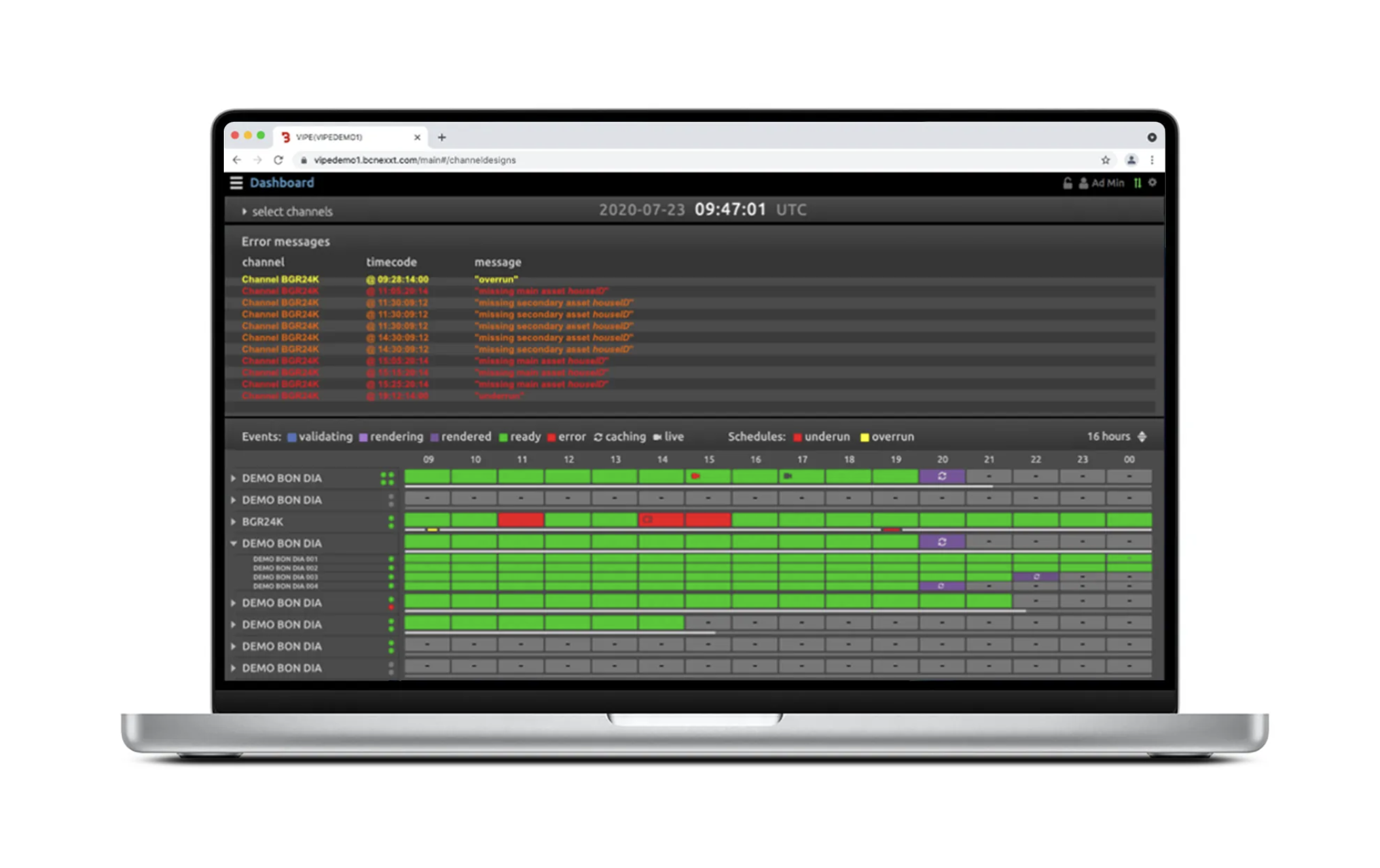
The playout system itself comes from BCNEXXT and is called Vipe. Besides classic program handling, it manages numerous additional functions: audio preset switching, signals for targeted ad replacement in the OTT sector, and automatic recordings. Traditionally, the playout operator at Sky also handles the audio – an efficiency gain through automation and intelligent presets that are individually configured for each program.
Content Hub: The End of Silo Thinking
Alongside the technological transformation, Sky established a content hub at the beginning of the year – less a technical system than a new organizational model. "We still had this vertical silo mentality of linear, digital, social," Reitano explains, describing the initial situation. The solution: everyone at one table, story-centric work across all platforms.
“The editor of the future is likely a content creator,” says Reitano. Someone who designs content for all distribution channels and masters the corresponding tools. The Avid Media Central structure has been adapted accordingly, and AI tools support prompting and material searches. “It makes no sense to edit a post for Instagram in a way that won’t work there,” says Reitano. If a Harry Kane goal is identified as a strong story, the content creator needs to know which platform will generate the most attention—and what the format should look like.
The technical infrastructure supports this: The new control rooms Sky is currently building will be 9:16-capable from the outset. "Previously, you simply built for HD or UHD," says Barth. "Now you build for all formats – even if it's 100:17." AI-supported tools help to efficiently manage the various aspect ratios. The operating concept in the control rooms has also changed: Instead of large, traditional video switchers, directors work with keyboards and shortcuts that they configure themselves – software automation instead of a hardware behemoth.
Sports analysis 2.0: The game as a video game
Perhaps the most ambitious project is the new sports analysis based on limb-tracking data. Camera systems have been installed in all Bundesliga stadiums, generating 3,600 data points per player. "You can translate the game into a virtual game in real time," Reitano explains, describing the current state of development of the new technology.
The possibilities are vast: showing goals from the perspective of the referee, the goalkeeper, or the opposing player; entering the complete 3D space surrounding a game scene; and displaying heat maps and statistics in real time. "This enables new forms of broadcasting, such as those used by ESPN, which created an animated Toy Story version of an NFL game," says Reitano, referring to the experimental formats of American networks. The game is completely virtualized in a 3D space – without any players having to wear motion-capture markers.
The catch: The photorealistic rendering of the players is still missing. Currently, they appear as "silver figures" in jerseys, but without individual facial features – EA Sports understandably doesn't release the licensed player models. The tracking technology comes from the company Tracab, which was recently acquired by EA Sports – an indication of where things might be headed. "The solution is currently still under development for live use; the second half of the season serves as an extended testing phase," explains Reitano.
AI as a development accelerator
Such leaps in innovation would be virtually inconceivable without artificial intelligence. But beyond the visible applications – speech-to-text, for example, or AI-supported material searches in the content hub – Barth sees the greatest impact in the backend. "Depending on the task, you can save up to 70 percent of development time." This applies primarily to the integration of interfaces and the adaptation of purchased software to existing workflows. Sky's strategy is to purchase software and then customize it with its own interfaces – AI significantly accelerates this process.
At the same time, more powerful standard components are opening up new possibilities. Barth cites the example of the new Nvidia Blackwell graphics card generation: "With these, you can encode video in optimal quality with very little programming effort." Previously, a specialized encoding manufacturer would have been necessary. Today, Sky thinks twice about whether the middleman is still needed. "The basic open-source stack is so easy to integrate that I'm becoming much more agile." An encoding prototype could be set up within a few weeks – technology that could be used in production next year.
Mobile First – even in the news
This agility is evident not only in the backend but also in daily production. The changing media landscape is particularly apparent in the Sky Sport News newsroom. "Most users see the news first on their mobile phones," says Reitano. Breaking news appears digitally first, and the news studio serves to categorize and contextualize it. For the past two years, reporters have been using only iPhones – traditional ENG crews no longer exist. "A gimbal, a light kit – and off we go," Reitano describes the setup. Any complaints from viewers about the picture quality? Never.
The technical consequence: The studio produces in HD, not UHD. The content reaches viewers primarily on mobile devices anyway. At the same time, the news channel remains an important anchor point within the Sky universe. "Many people come to our platform and have Sky Sport News as their number one channel," says Reitano. "From there, they then move on to the other channels."
Closer to the game
Ultimately, all technological investments are geared towards a goal recently coined by the DFL with the slogan "Closer to the Game." Reitano picks up on this: more proximity, more perspectives, more emotion – whether through cameras that follow the player from the bus to the locker room, referee cameras, or wired coaches during warm-ups.
“The football purist wants nothing to do with that,” Reitano admits. But Sky already caters to them with the classic live broadcast. The younger generation, however, raised on EA Sports and PlayStation, expects something different: data, gamification, new perspectives. “The better you can translate the game like a video game, the more appealing it will be for the next generation.”
A tour of the Cube reveals that Sky isn't simply rebuilding – the broadcaster is rethinking sports production. IP infrastructure, cloud playout, content hub, limb tracking: the individual components combine to form a strategy that blends technological flexibility with changing viewing habits. The transformation is far from complete – but the direction is clear.




.jpg)




.jpg)
.jpg)
.jpg)

.jpg)
.jpg)










.jpg)


.png)


