Graham Sharp, VP of Sales & Marketing at BCNEXXT, shares his perspective on the FCC’s potential upper C-Band spectrum clawback and what it could mean for broadcast distribution.
America’s growing demand for mobile wireless services may soon disrupt another part of the broadcast ecosystem under pressure.
The FCC has opened a Notice of Inquiry (GN Docket 25-59) into the upper C-Band spectrum (3.98–4.2 GHz), inviting feedback on options for more intensive use of frequencies that are currently used extensively for radio and television distribution. This inquiry follows the FCC’s 2020 decision to repurpose the lower C-Band from satellite broadcast contribution use to mobile flexible wireless services.
For broadcasters, the upper C-Band remains a critical part of traditional distribution infrastructure, supporting the delivery of live news, sports, and entertainment programming to local affiliate stations, cable headends, and other downstream distribution networks across the United States.
If this inquiry follows a similar path to 2020, it could trigger another large-scale transition, this time affecting the distribution side of broadcast operations.
Deja Vu: Spectrum Reallocation Forces Structural Change
When the lower C-Band spectrum was reallocated in 2020, the resulting auction raised $81 billion, with a portion of the proceeds allocated to help broadcasters relocate and modernize contribution workflows that suddenly lost access to spectrum.
That transition accelerated the industry’s move toward IP-based contribution and permanently changed how live content is transported. What might have taken a decade under normal conditions happened in a matter of years, driven by regulation and supported by funding.
The same approach applied to the upper C-Band could have a similar impact and accelerate the obvious move to IP distribution.
In an industry that is hugely cost-overhung and searching for new revenue streams, this could create huge opportunities to reduce cost and open up new sources of revenue funded at least partially by the government.
Distribution by IP
Instead of delivering fully assembled channels via satellite, content, schedules, and metadata could be delivered over IP to the local headend. The channel is then created locally, which enables:
- Lower infrastructure and distribution costs
- Increased revenue through hyperlocal advertising and targeted content
- Increase reliability with a multipath architecture and redundant, independently operating playout servers
To implement this, the faithful IRD in the head end is replaced with either a small playout server or a lightweight cloud instance, connected to an IP network, and the onward distribution network remains the same.
The server has a cache for file content and can switch to local live IP feeds. It also has a copy of the schedule downloaded to it, so if the network is lost, it can operate independently, either playing back cached content, or if it has not been downloaded yet, evergreen emergency content.
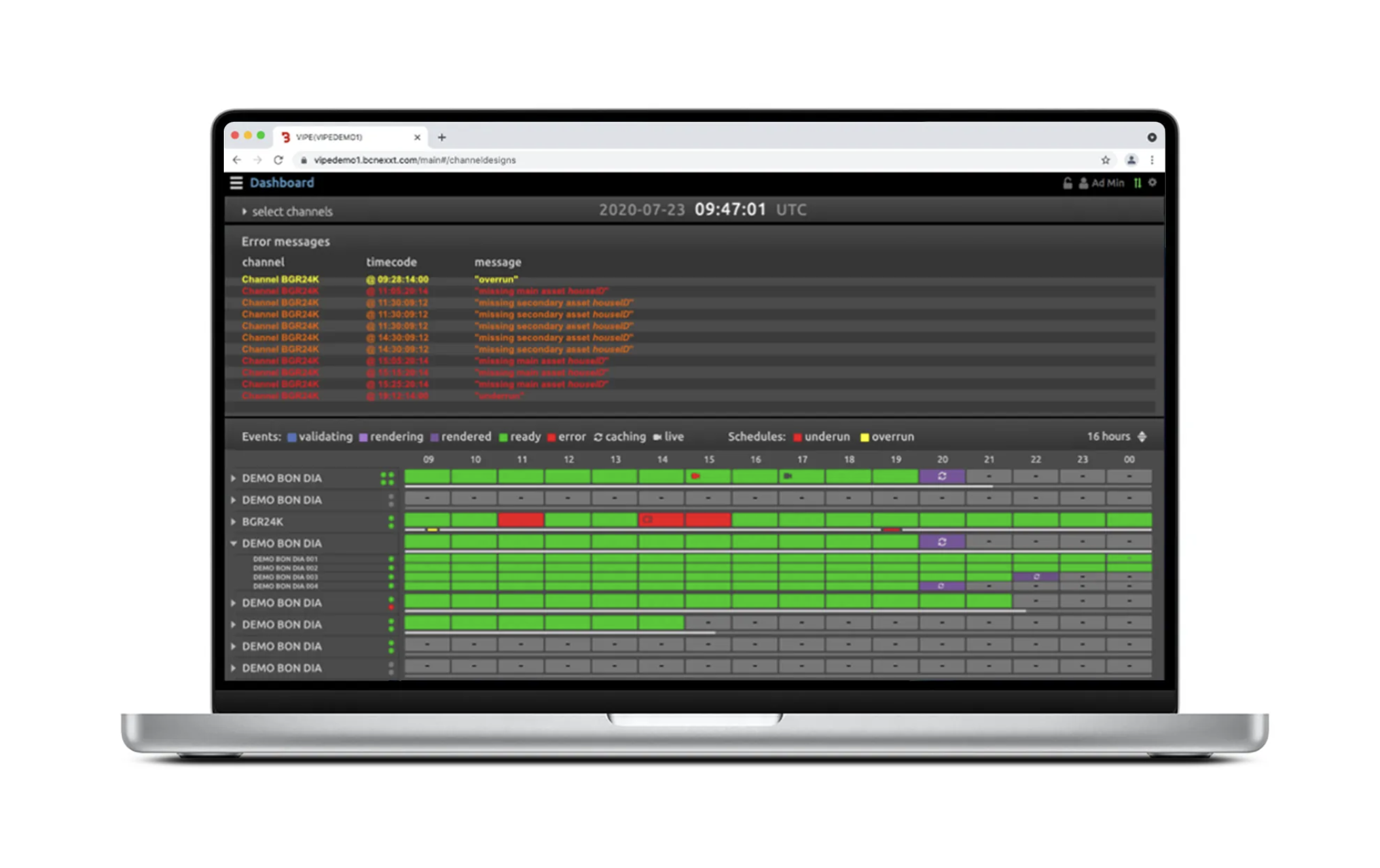
This distributed IP architecture is exactly the architecture BCNEXXT has implemented in Vipe, which was designed from the ground up for distributed, IP-based playout, rather than centralized, hardware-dependent broadcast architectures.
The Business Impact: Lower Cost, Greater Flexibility
Beyond replacing satellite infrastructure, Vipe enables a materially different cost and operating model for station groups and network operators:
- Proven playout cost reductions of 60% or more: by scaling resources to match the content
- Higher channel-to-operator ratios: through automation and exception-driven management
- Ultra-high reliability: Proven 99.9999% availability with fewer on-air errors
- Simplified localization: Regional variants and targeted content become operationally viable
- Platform consolidation: Linear, streaming, and VoD delivered from a single platform and user interface
For broadcasters, this directly improves cost efficiency per channel while increasing the ability to monetize at the local and regional level.
Financial Support Drives Efficiency & Monetization
If the FCC chooses to fund the transition, broadcasters may face a rare opportunity
whereby they arefinancially supported to replace infrastructure that already limits flexibility and profitability.
Rather than treating the potential C-Band clawback as a like-for-like replacement exercise, station groups can use it as a catalyst to modernize distribution in ways that:
- Reduce long-term operating costs
- Improve monetization flexibility
- Simplify operations across linear and streaming
- Future-proof distribution against further spectrum or market shifts
Looking Ahead
At BCNEXXT, this potential transition reinforces our core mission: helping broadcasters modernize playout and distribution to operate more efficiently, monetize more effectively, and adapt to change without disruption.
The spectrum may be the trigger, but the real opportunity lies in using this moment to rethink how broadcast distribution is built, operated, and monetized for the next decade.
We are deep in discussions with colleagues and customers. We welcome you to reach out to discuss a clawback game plan that creates a better business outcome for you.

.jpg)


.jpg)

.jpg)
.jpg)
.jpg)
.jpg)
.jpg)






.jpg)


.png)


