Graham Sharp, VP of Sales and Marketing at BCNEXXT, explores in his latest blog why the industry must move beyond asking whether a product “has AI” and focus on what that intelligence actually achieves.
From NAB to IBC, there is one topic that has dominated the media technology conversation this year: Artificial Intelligence. AI is being attached to products and demonstrations across the industry, with vendors promising new ways to generate, analyze, automate and optimize almost every part of the media workflow.
And yes, there is a lot to be excited about. But amid the AI frenzy, we have lost a bit of focus on what's really important. And that's the problem we are trying to solve.
When it comes to playout, we're asking the wrong question. Instead of asking how we can put more Artificial Intelligence into playout, we should be asking how we can make playout itself more intelligent.
For BCNEXXT, that means IA: Intelligent Automation.
Playout Has an Operational Problem
Broadcast playout has been automated for decades. Schedules are created, media is prepared, rules are applied, and content is transmitted reliably to air. Deterministic automation has done that job extremely well, and it remains fundamental to broadcast operations.
What has changed is the environment around it.
Today's broadcasters are managing more channels and live services alongside FAST, OTT and streaming. They are dealing with more regional and language variants, more versions of content, increasingly sophisticated advertising requirements, richer metadata and more formats. All of this is happening while media organizations are being asked to operate more efficiently and reduce costs.
The result is a contradiction that anyone running a modern broadcast operation will recognize: playout is becoming more complex at the same time that we need to make it simpler to operate.
This is where I question whether simply adding AI to an existing playout system gets us very far. The fact that a system can call an AI model doesn't inherently make the operation more intelligent. What matters is whether intelligence is being applied to the decisions and workflows that determine how content is prepared, monitored, and ultimately delivered.
From Automation to Intelligent Automation
This is the thinking behind Vipe.
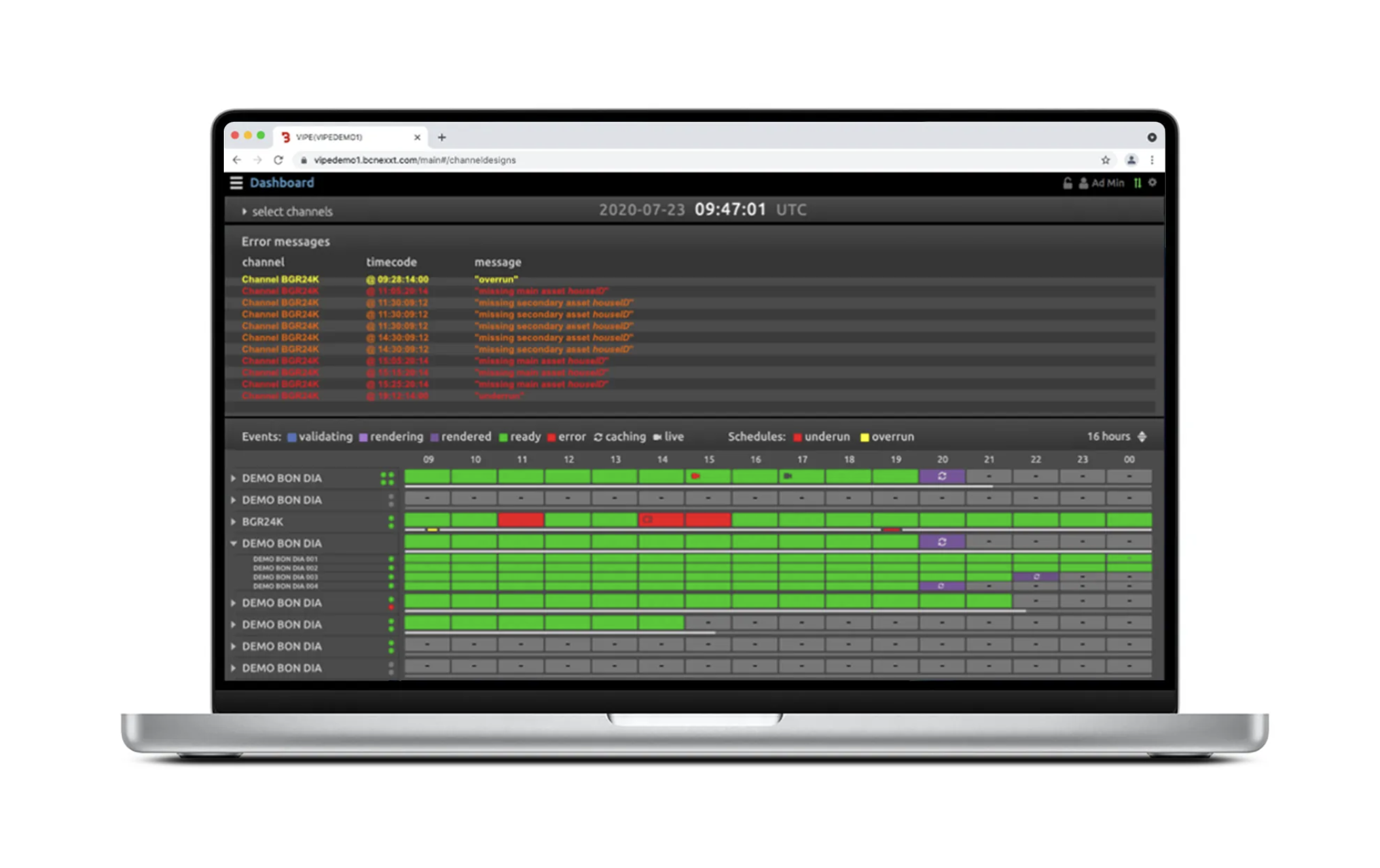
Rather than treating AI as a separate feature or application, Intelligent Automation is built into the playout environment. Vipe can understand the content and metadata associated with media assets, identify patterns and potential issues, automate repetitive processes and provide operators with contextual information that helps them make better and faster decisions.
That changes what automation can do.
A traditional automated system can execute the playlist it has been given. An intelligent system can also help identify that an asset is missing, that metadata is inconsistent, that an unusual operational condition has occurred or that there is a potential problem in the playlist before it becomes a transmission issue.
The distinction is important. We aren't trying to make playout intelligent simply for the sake of saying it uses AI. We're trying to reduce the amount of manual work required to operate increasingly sophisticated services while improving reliability and control.
From Monitoring Everything to Managing What Matters
One of the biggest opportunities is to rethink the relationship between the operator and the playout system.
As operations become more complex, simply giving people more information isn't particularly helpful. Operators don't need another dashboard filled with data or another stream of alerts they have to investigate. They need the system to understand what is happening well enough to distinguish normal operations from something that actually requires attention.
That is the shift from monitoring everything to managing by exception.
If a channel is operating normally, the operator shouldn't need to spend time watching it. If something unusual occurs, Vipe can identify the issue, prioritize it and provide the context needed to determine what happens next.
This doesn't remove the operator. It makes much better use of them. Experienced broadcast professionals can spend their time dealing with the situations that genuinely require their expertise rather than repeatedly checking processes that are functioning exactly as expected. As broadcasters look to operate more channels and services without simply adding more people, that becomes increasingly important.
Intelligence Still Needs Boundaries
There is another reason I think Intelligent Automation is a more useful conversation for playout than generic AI: broadcasters are understandably cautious about giving an AI system unrestricted control over what goes to air.
And they should be.
Reliability and predictability aren't legacy concepts we need to eliminate from broadcasting. They are fundamental requirements. The opportunity is to add intelligence without sacrificing either.
Vipe therefore operates across three complementary layers.
- Deterministic broadcast control continues to execute critical playout operations reliably.
- Intelligent Automation analyzes information, identifies issues, makes recommendations and automates appropriate tasks.
- Human governance ensures that operators and administrators retain control over the decisions that require their judgment.
This allows broadcasters to introduce greater autonomy progressively, based on where it makes operational sense, rather than making an all-or-nothing leap into AI-driven playout.
Focus on the Outcome, Not the Acronym
The conversation around AI isn't going away, nor should it. But we need to get beyond asking whether a product "has AI" and start asking what that intelligence actually achieves.
For playout, the measures that matter are operational. Does it eliminate repetitive work? Identify problems before they become transmission incidents? Help operators focus on what actually requires their attention? Enable teams to manage more channels and greater complexity without sacrificing reliability and control?
The goal isn't to automate everything or remove people from the operation. It's to determine what the system can handle intelligently, what can safely happen autonomously, and where human expertise adds the most value.
Ultimately, broadcasters don't need AI for the sake of having AI. They need technology that makes increasingly complex playout simpler to run, more efficient to scale and more reliable to operate.
The question isn't whether AI belongs in playout. It's what intelligence can actually do for your operation. Discover how Vipe is putting Intelligent Automation to work in playout. Book a demo: info@bcnexxt.com.





.jpg)




.jpg)
.jpg)
.jpg)

.jpg)
.jpg)













.jpg)


.png)


