Graham Sharp, VP of Sales and Marketing at BCNEXXT, explains why virtualization can be a future problem in disguise and how Vipe’s containerized architecture supports more efficient, flexible media operations.
As media organizations modernize infrastructure and adopt cloud-native technologies, two terms are frequently used: virtualization and containerization. While both improve how applications are deployed and managed, they solve different problems and have distinct architectural approaches.
Understanding the difference is important for anyone evaluating modern media and playout technologies.
Virtualization in BCNEXXT’ view is a future problem in disguise.
What is Virtualization?
Virtualization enables multiple operating systems to run on a single physical server. Each virtual machine (VM) contains its own operating system, application, libraries and supporting files, all managed by a hypervisor.
Think of virtualization like an apartment building. Every apartment is a complete home with its own plumbing, electrical system and living space. While each apartment is independent, duplicating that infrastructure makes every unit larger and more resource-intensive.
What is Containerization?
Containerization packages an application and its dependencies into lightweight containers that share a single operating system kernel. Rather than running separate operating systems, containers operate as isolated processes on the same host.
A useful analogy is an RV park. Each RV is self-contained but shares the park's infrastructure. Because they don't duplicate the underlying operating system, containers are smaller, start almost instantly and make much more efficient use of available compute resources.
Virtualization vs. Containerization: Key Differences
Virtualization
Containerization
Runs multiple operating systems on one server
Shares a single operating system kernel
Each VM includes a full operating system
Containers package only the application and its dependencies
Higher CPU, memory and storage requirements
Lightweight and resource efficient
Slower startup times
Near-instant startup
Hardware-level isolation
Process-level isolation
Well suited for running multiple operating systems
Ideal for cloud-native, microservices-based applications
Why Containerization Matters
Containerization has become the preferred architecture for many modern cloud-native applications because it enables faster deployment, greater scalability and more efficient use of infrastructure. Applications can be updated, scaled or restarted independently, making operations more agile and resilient.
For media organizations, these characteristics are particularly valuable as workflows become increasingly software-defined and dynamically orchestrated.
How Vipe Applies Containerization
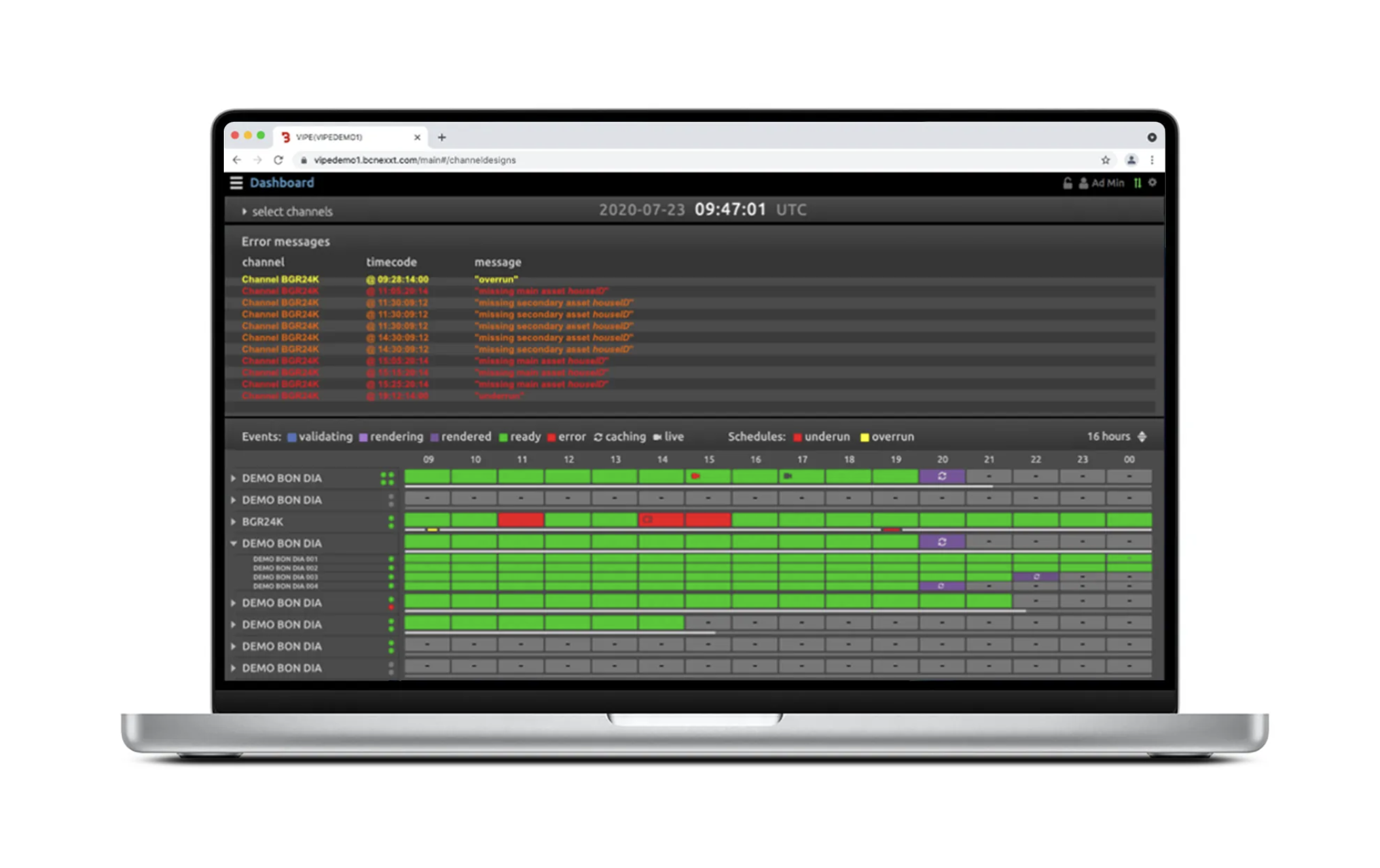
Vipe was designed from the ground up as a cloud-native playout platform built on containerized microservices. This architecture allows individual services to scale independently and resources to be allocated dynamically based on operational demand.
Combined with Vipe's unique approach of separating content preparation from real-time playout, containerization helps broadcasters maximize infrastructure efficiency while supporting flexible deployment across on-premises, private cloud and public cloud environments.
Schedule a meeting at IBC2026 to learn more about Vipe: https://www.bcnexxt.com/ibc.
To learn more about the Vipe playout workflow, please visit https://www.bcnexxt.com/approach.




.jpg)
.jpg)
.jpg)
.jpg)

.jpg)
.jpg)












.jpg)


.png)


