Graham Sharp, VP of Sales and Marketing at BCNEXXT, explains what true cloud-native technology means for broadcast and why it delivers greater flexibility, scalability and cost efficiency.
If you search ‘Cloud Native’, the results talks about four technologies and practices:
1. The use of Microservices:
Instead of a huge monolithic codebase, applications are built from small independent services which perform a specific function and communicate with each other using APIs.
2. Containers:
These Microservices are packaged into containers (Dockers being one example) that contain everything required to run them, making them easily portable across hosting environments.
3. Orchestration:
There are various tools (Kubernetes being an example) that manage the containers and do the scaling, load balancing, self-healing and other optimization tasks
4. DevOps:
Continuous integration and delivery enable engineering teams to provide frequent code updates to individual services without shutting the whole application down. This simplifies QC and hardening, negating the requirement to regression test the whole application on each update.
The benefits of ‘Cloud Native’
Cloud native environments provide speed, agility, efficiency and adaptability. New features can be shipped faster, providing agility in changing markets and scalable products can be built that are both efficient and reliable.
By understanding the advantages, characteristics, deployment and delivery models of cloud computing, organizations can harness the power of the cloud to drive innovation, accelerate growth, and stay competitive in today’s digital landscape.
Cloud products in the Broadcast market
The first use of the Cloud in Broadcast was about 10 years ago when it started to be used to host virtual machines. Virtual machines are basically servers in the cloud that run an OS such as Windows, just like hardware on premises. Typically, the application is ‘lifted and shifted’ to this environment and therefore does not use all the cloud's native advantages.
The advantage of a lift and shift strategy is speed – an existing application can be running in the cloud very quickly; however, the disadvantages are many, it does not use any of the advantages, usually costs more to operate and the developer has to continue supporting old code, the old way.
This resulted in a push back against the cloud. Early adopters found in many cases their cloud hosted applications proved less reliable and more expensive than what they had before.
Fundamentally, this has led to a lack of understanding of the way the cloud works natively, the financial benefits the cloud brings and importantly the difference between software that has been lifted and shifted to the cloud and software that is written for the cloud.
The next step for those initial ‘lifters and shifters’ was to utilize the tools and systems that some cloud vendors, particularly AWS, provided in their eagerness to increase adoption. This has then created another, different problem. By using proprietary tools those vendors achieved some partial advantages of being cloud native, but in doing so, they locked themselves to a single cloud vendor and, importantly their pricing. In addition, with many broadcasters concerned with sovereignty issues, being locked into a single vendor does not help.
This means the cloud adoption rate is much lower than we think, as everyone searches for a solution that brings the advantages of being truly Cloud Native, whilst not being locked into a single cloud vendor.
Without a doubt, cloud computing has transformed the way businesses can operate, offering unparalleled scalability, flexibility, and cost-efficiency. The trick is to find the right application vendor.
Rather than adapting legacy playout software to run in the cloud, BCNEXXT believed from the very beginning that the only way to fully unlock the benefits of cloud computing was to build for the cloud natively. When the company was founded in 2015, this vision was far from mainstream. While much of the industry focused on virtualizing existing applications, BCNEXXT invested all of its expertise into developing a modern cloud-native architecture from the ground up. The team recognised early that this was not simply the next step in playout technology—it was the future. That long-term commitment now enables broadcasters and service providers to benefit from a platform that delivers the scalability, flexibility, resilience and cost-efficiency that true cloud-native technology was always intended to provide.
Founded in 2015, BCNEXXT united experienced broadcast and playout experts around a shared vision: to build a playout platform designed for the cloud from day one. Starting with a clean sheet of paper, the team reimagined traditional playout using a truly cloud-native architecture and the latest available technologies.
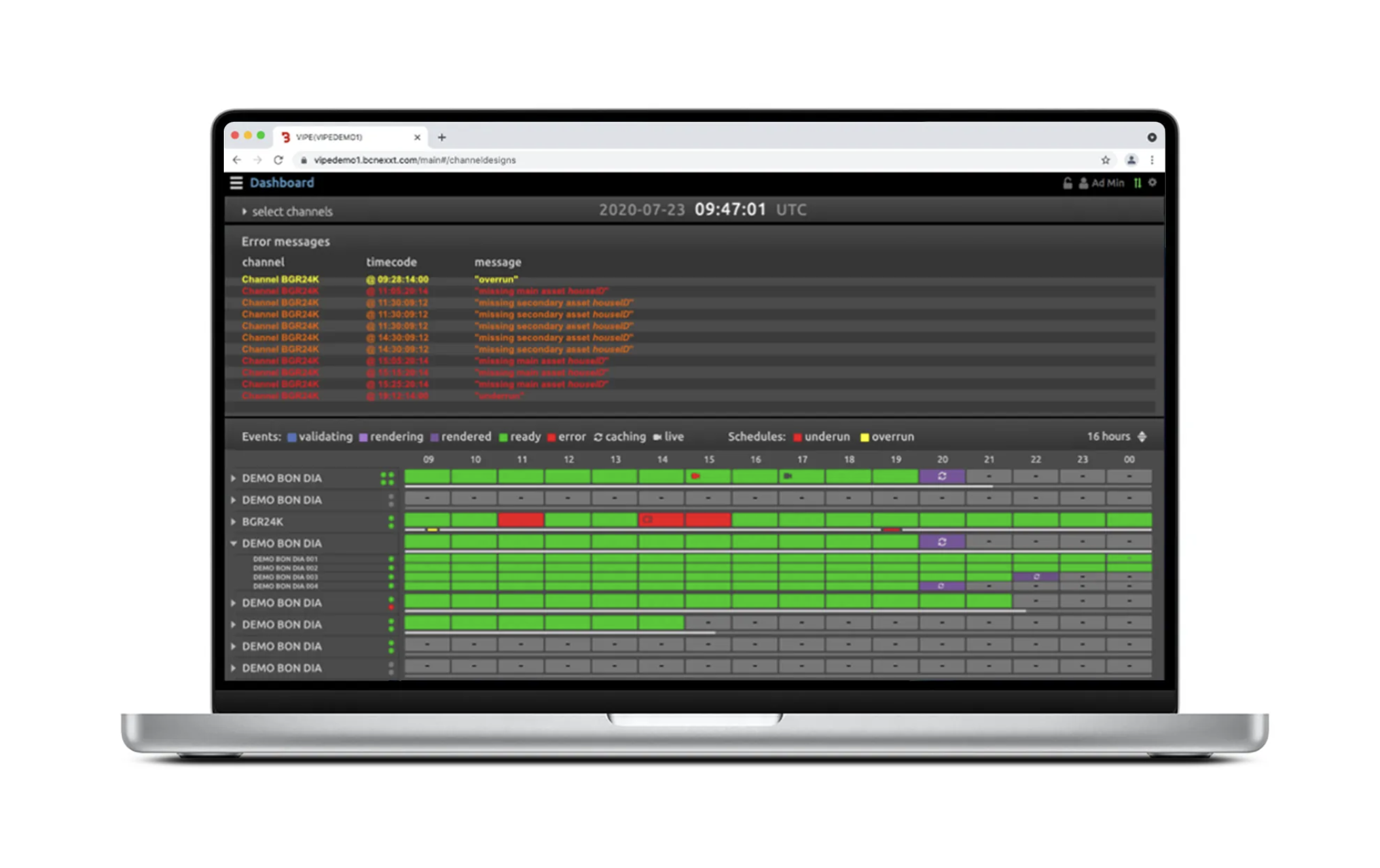
Vipe by BCNEXXT is our cloud-native playout solution. It offers an operating model for efficiency, scalability, and profitability. Contact us to learn more: info@bcnexxt.com.





.jpg)



.jpg)
.jpg)
.jpg)

.jpg)
.jpg)












.jpg)


.png)


