Graham Sharp, VP Sales & Marketing at BCNEXXT, explains how disassembling the traditional playout process can simplify operations and deliver cost savings of up to 80% with Vipe.
Disassembling the playout process
Traditional broadcast playout is handled by monolithic servers with enough compute power to assemble content elements in real-time, at the point of playback. It’s provisioned for the most complex content. It's always on, even when it is only playing back a movie file.
When content preparation is separated from playout, as in our Vipe solution, we can simplify the ‘always-on’ playout server to a ‘splicer’ of compressed transport streams, requiring minimal compute.
Content preparation can be done upstream and is "scalable" based on the type of content. Microservices, like adding complex graphics DVE moves etc., and the associated compute power are used only when required. Once encoded, Vipe performs 90 quality checks to ensure the integrity of the file and/or stream.
Each piece of content, including live, is only assembled once, stored in the TS stream format, and reused multiple times, both within a channel and across channels. Even for backup and DR, the content is distributed to a backup server – the content is NOT assembled and encoded again.
Background to the technology
Cloud-native software is written in small self-contained chunks, that can be scaled up and down based on demand: this is what is meant by containerized microservices. They can be easily interfaced to other small functional chunks, or microservices, to create a product or services and can be individually turned on or off, based on the task at hand and importantly, as they are turned off, they release computer resources – so they only consume compute power when they are on and performing a task.
This is clearly much more cost-efficient than buying a server or booking a virtual machine which is always on.
Cloud vendors meter resource usage very granularly and bill accordingly. For example, a detailed AWS bill is amazing in its granularity, down to interrupts billed at fractions of cents.
Well-architected, efficient, modern software built around containerized microservices take full advantage of this granularity to ensure the user only pays for what resources are consumed. This is the foundation of Vipe.
Encoding
Traditional playout goes through several concatenated compression processes as it is distributed to the consumer.
With Vipe, we encode as the content is assembled, even for live. The downstream distribution and storage are in a compressed format, keeping infrastructure costs down to a fraction of those for higher bandwidth.
This also enables an ‘edge’ server model, where low-bandwidth, low-cost but robust IP distribution is used to provide regionalized content to edge servers, which can cache file-based content and schedules, switch in live, and operate independently even if the network fails.
As the FCC mandates the claw back of the upper C-Band distribution frequencies, low cost and robust IP edge casting not only offers a viable alternative to satellite distribution and provides opportunities for additional monetization by inserting local content.
Supply chain
Broadcast distribution has developed sequentially: linear, VOD, streaming etc. Each created a new playout silo requiring different resources.
Various versions of the same content had to be produced and delivered to multiple end points, and importantly, without a single point of control.
Vipe disassembles the contribution process for all distribution methods. All versions are assembled and encoded on a single platform. Source content delivered to a single endpoint. Silos eliminated. Supply chain vastly simplified.
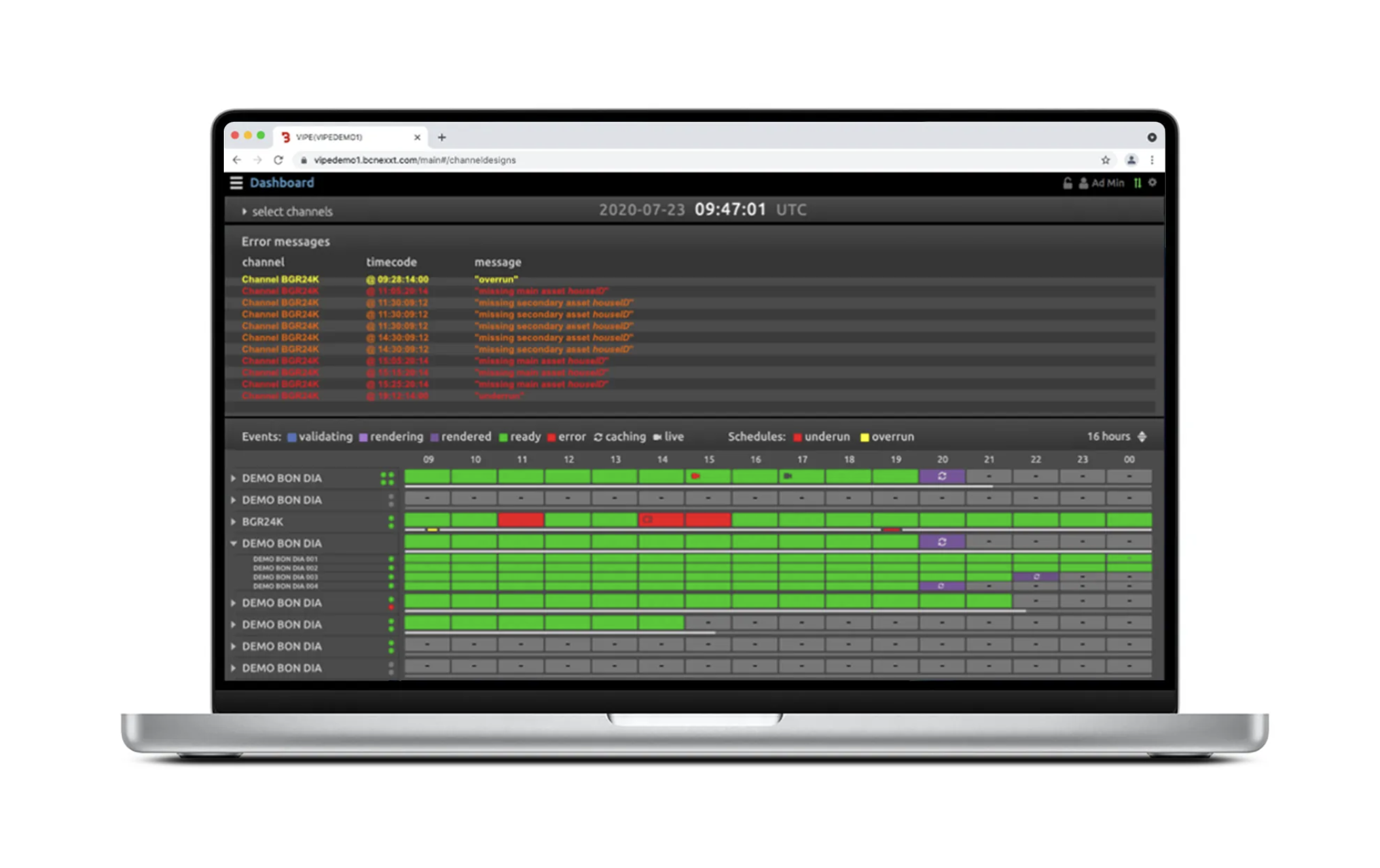
Sports, Multichannel, regional opt outs, VoD, FAST channels can all be flexibly managed from a simple, single point of control. Services can be spun up and down at will.
Summary
Breaking the ‘1 channel requires 1 server’ model unshackles operations from fixed, expensive, legacy technology, enabling new operating models that adapt to media’s changing business environment by turning content and playout operations into scalable, software-deployable solutions.
The ‘always on’ part of Playout becomes the assembly of transmission stream files and is very light weight, requiring 10-15% of the CPU power of a regular Playout Server, e.g. a conventionally sized single channel playout server can play back 8 channels.
Content preparation, assembly, encoding and QC is performed at the source and scales to the complexity of the content. All the formats required for multichannel distribution are created from a single mezzanine file, simplifying supply chain and files are prepared once and used many times.
The results are dramatic; by only paying for what they play, users report between 60% and 80% cost savings through hugely reduced infrastructure costs, reduced staffing levels and less on-air errors.
Free the shackles and liberate your playout; take a look at Vipe from BCNEXXT: https://www.bcnexxt.com/about-vipe
.jpg)
.jpg)




.jpg)


.jpg)
.jpg)
.jpg)
.jpg)
.jpg)









.jpg)


.png)


